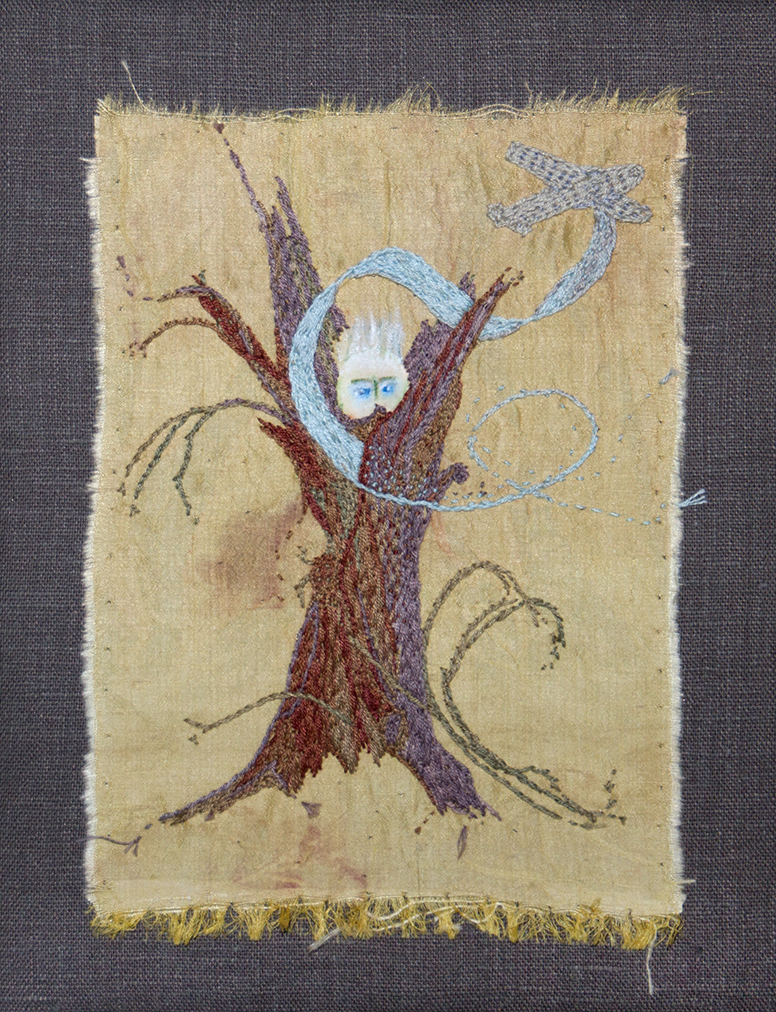
“His life, it was too short, so short.” Catherine closed the file, waved it in the air, as if she could conjure him back. He wished she had that magic, to bring back lives just as she brought life back to her artifacts. “He was the dearest soul I know, and never had a chance.” She looked to Thomas, and snuffed with her emotions. Clem and Thomas curled like brackets on either side of her, handing out tissues, murmuring kind words. Under her lashes, she looked his way, and TinTin knew she wasn’t looking for comfort. Like him, she was looking for those bits of Pi that she could carry forward. His work, his life, his thoughts—curated and alive because she bothered, and knew he would too. Shit, he’d finally been drawn into Catherine’s orbit, and from the looks of it, his first job was to rescue her.
“Look,” TinTin said, “you guys are staying for the night, so let’s forget this until the morning. The project is good. I say we order in beer and Chinese food and work our way through the vintage games. Pi would like that.”
Catherine lifted her head. “Vintage games?”
“Yes.”
Thomas laughed out loud. “He means video games.”
“There are vintage video games? I love them already.”
The Bones: Crossing, Chapter 7 by Laura Wythe (available on Amazon)
“The GPS says the phone is here. That Pi should be here.”
“This is weird, even for Pi.” Clem looked at the GPS location, then around the area. She dialed Pi’s phone to hear the ring. It came from above, from the branches of the great tree. TinTin boosted her up to get it. It was still ringing, and he reached out for it, hung up on his call.
“We don’t want to know how it got there, do we?”
“In the name of science we do, so let’s see what he’s done.” TinTin scrolled through the functions, found the most recent date stamps. “He was recording, so he wouldn’t have paid attention to our texts.”
They looked at each other. “Better play it.”
Crackles, pops. It’s ozone man, coming from the ground. It stinks like a bad connection on an electric streetcar. Violent pops. The unmistakable sizzle of electricity. One, two, three explosions, like artillery. Four, five, six. Seven. A hit, no warning whistle to proceed it.
TinTin felt ill.
The Bones: Crossing, Chapter 7 by Laura Wythe (available on Amazon)
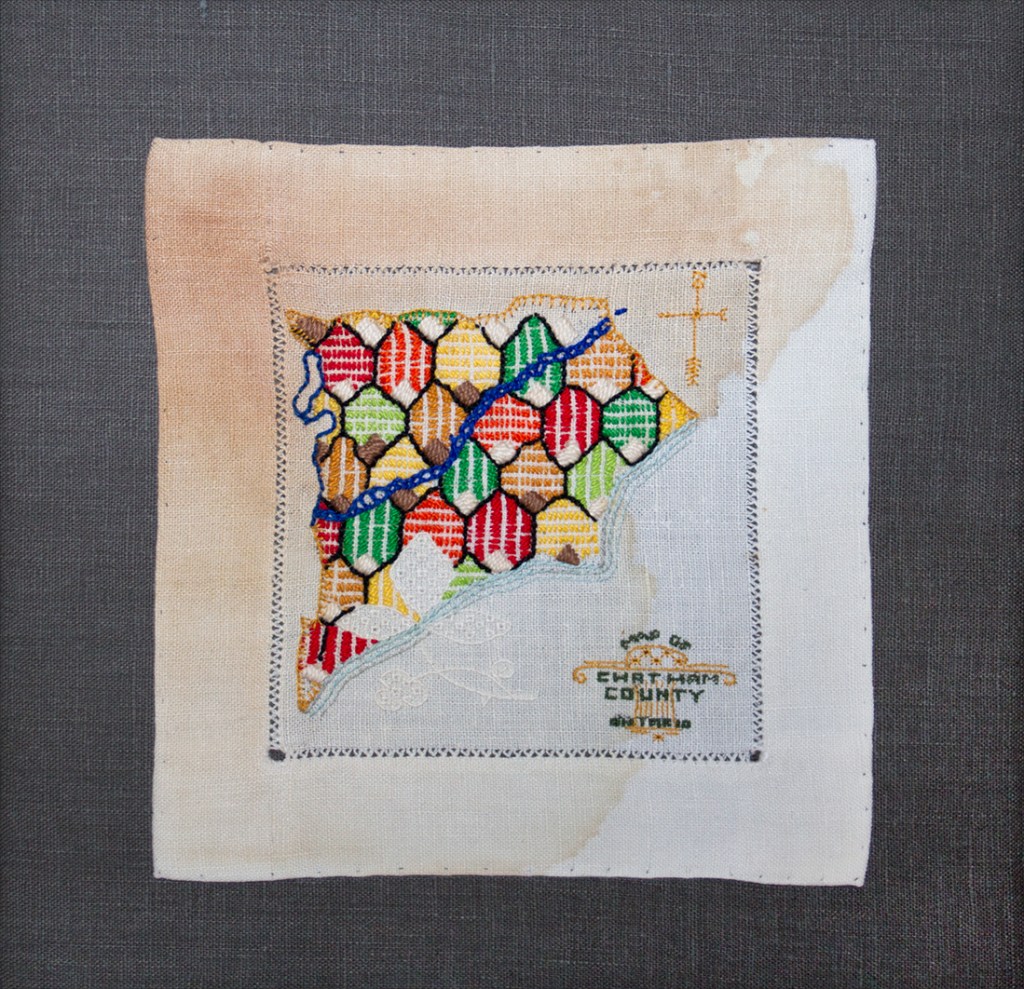
Woven into the Fabric of Chatham County by Laura Wythe
“The town hates me.”
“It would be the same if I went to live with you in Gaza. A newcomer waltzes in and they think she wants a share of the pie she hasn’t earned yet. I will spend my life fitting you into my arms, my heart, my life. But the town has to work you among the many into its fabric until you’re seamless. Only recently has Dad been that pliable, or willing to spend the time.”
“Your parents do realize that the whole area is sunk after the bicentennial.”
“Mom says there’s some kind of programming that makes her return like a spawning salmon and that’s why she won’t give it up easily.”
Clem sighed and pretended to scoop up sunlight by the handsful, let it trickle through her fingers onto the covers.
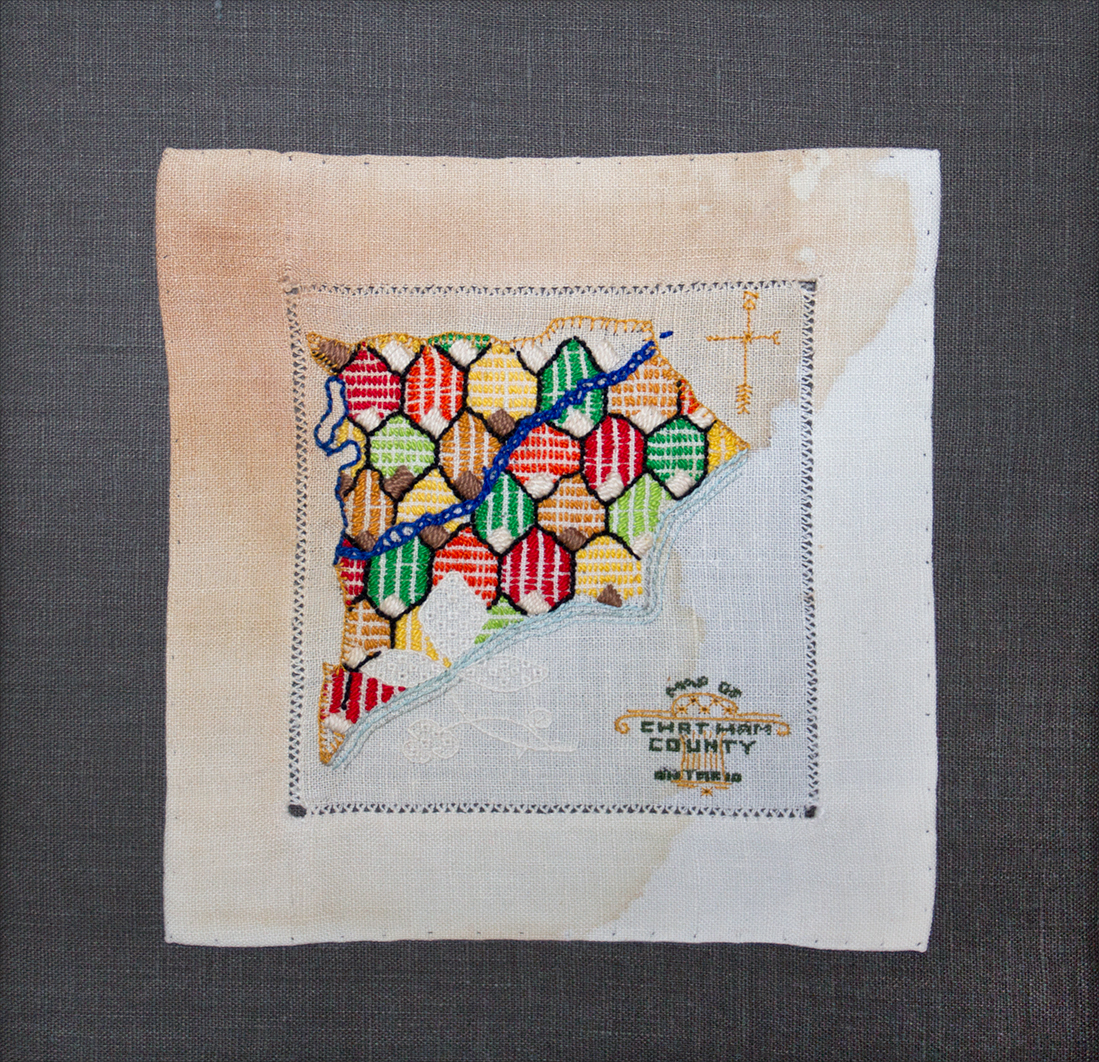
“The fabric of Catherine’s childhood is unravelling,” TinTin said, sighing, as Clem rubbed her warm hands on his arm. “This social fabric of which you are a thread, would it perhaps be another kind of Net worth studying?”
“I think it’s been studied enough. There’s never been a culture more documented and headstrong than my mother’s.”
The Bones: Crossing, Chapter 7 by Laura Wythe (available on Amazon)
He didn’t think the town was racist. They had their way of sorting people, of keeping them honest. The Wests had Indian blood from the frontier days and the genes popped up in random generations–two in a row with his dad and his sister. It wasn’t a big deal. It wasn’t something the town let them forget. Even with his fair colour, he got his share of teasing. Rebecca, well, she got teased about everything and maybe the link to Tecumseh was just the last straw. The Galloways, they’d climbed the social ladder and right on up into the early government. The link to Tecumseh stuck but the family had always taken a hard line that nothing happened between old Rebekah and the Shawnee. None of their generations had come out brown-skinned like his father and his sister, so maybe it was true. In the end, Miles believed what mattered most was how people treated one another.
The Bones: The Crossing, Chapter 3 by Laura Wythe (Available on Amazon)
People all over the world claimed to be in touch with the rain, but Clem believed the whisperers who gathered the most media buzz were liars. Sure, small miracles did happen. Some prayers were answered, how many out of millions? The genuine survivors told how it felt like they’d died and only when they had given up all hope and struggle, only then, had the water, or the weather itself, carried them to safety. They had submitted.
Clem stopped asking for data. She surrendered to the rain.
The Bones, Wooing, Chapter 19 by Laura Wythe (available on Amazon)
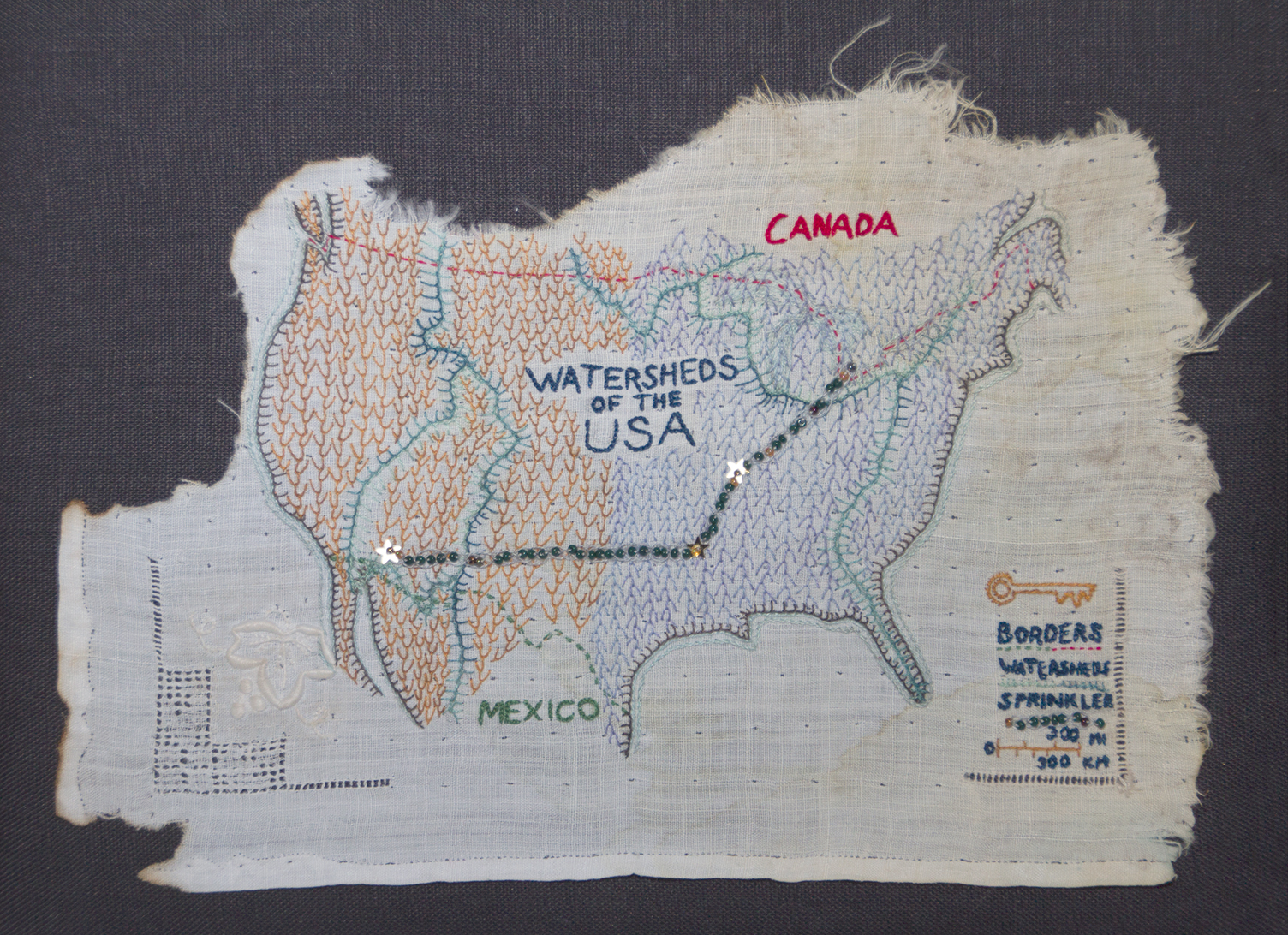
The Bones illustrated from Text to Textile show (2018) Sprinkler System by Laura Wythe
“So, where did the water go?” she asked.
“It rose fifty feet and was wicked above the tower lines to Sandusky.”
“Then it followed the Mississippi.”
“It ran along that corridor like a series of beads. Bring up the video feed and show her.”
Pi did, and in the corner of her screen he used the cursor to show her the sequence. “Then it reached Oklahoma and we shunted it west.”
“We’re still waiting for it to drop.”
“Still aiming for Uncle Walter’s pool in Phoenix?” Clem asked.
“Ha! He’ll wonder where that came from.”
“Actually, Pi, he’ll never know.” TinTin said this with relief. “He’s visiting my folks in Jericho. He heard they’re getting rains and he likes the idea of a green desert. We’ve tapped into his home security cameras. This small quantity of water should evaporate in less than two hours. Such is the arid state of Arizona.”
The Bones: Wooing, Chapter 18 by Laura Wythe (available on Amazon)
I’m done with disasters for now. And yet, there is still work to done, both personally and as part of the collective that lives on a shared planet. If there’s one thing that has remained true in 2020, it’s the connection to earth and the precious air we share. How visible that space is now! I work through electronic media, I visit and take courses in the same way. People I see in person are masked, with all that evokes. The trees, rivers, lawns, gardens, birds, critters, bugs, sky and weather remain immediate and true to form. One of my favourite “earth” connections this year is the food that a CSA farm delivers to my doorstep.
My novel, The Bones and the art show that followed its publication needs to wrap up one last thing before I move on to the next large project. I would like to finish sharing with everyone the rest of the work from Text to Textiles, the display of illustrations I made for The Bones. Some are sold, others are nested safely for another day.
Text to Textiles was based on the idea that the main driver of the plot in The Bones, Catherine, is the head textile curator at the Royal Ontario Musuem. She goes back to her family farm which is inundated with flood waters to gather textile artifacts and also to search out for the bones of Tecumseh. One is a great motive, the other rather obsessive, patriarchal, colonial, etc., etc..
There seemed no better way to illustrate The Bones than through stressing common Ontario Loyalist textiles after they are embroidered with traditional stitches. Less traditional materials are used to highlight Catherine’s daughter’s views. And then there are emboideries on silk with somewhat Gothic representations that link to another character and the silk memorial embroideries that would have been popular with Loyalists after the War of 1812.
I will make individual posts with the text below to carry on where I left off, but for now, enjoy the slide show!
Stricken City by Laura Wythe
Tecumseh Fell Here by Laura Wythe
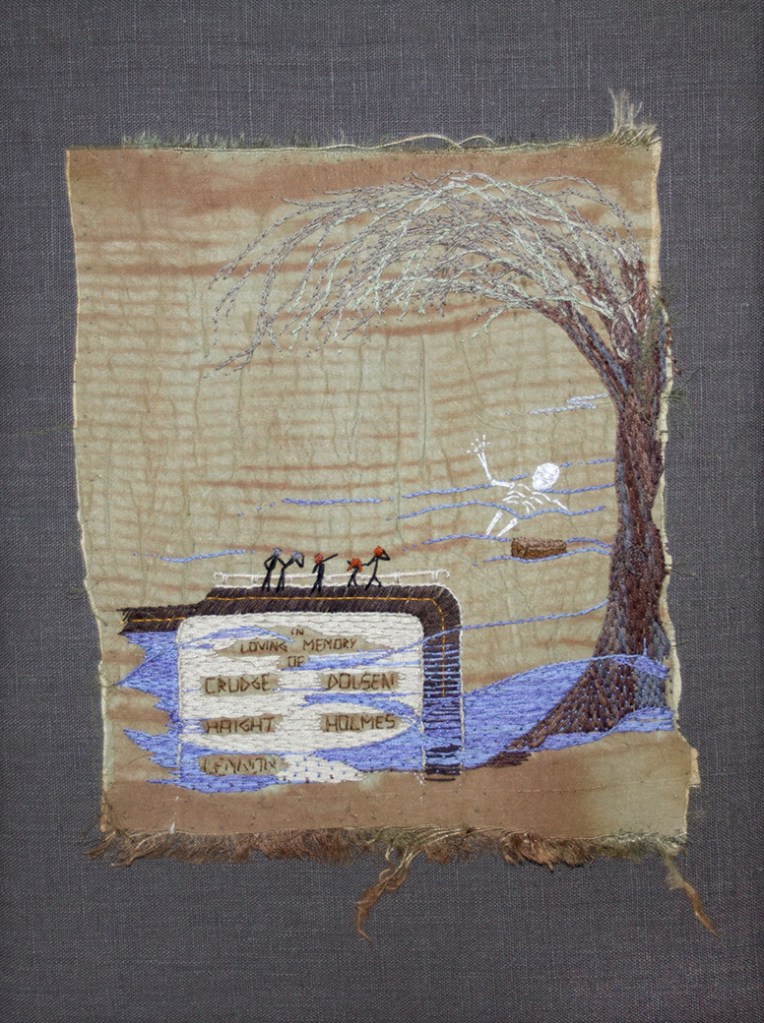
Safety Net: the Annex Trial by Laura Wythe
Witness to Purity by Laura Wythe
Rebecca, the Last Galloway by Laura Wythe
Caskets on the Loose by Laura Wythe
Sprinkler System by Laura Wythe
Rain Whisperer by Laura Wythe
Indian Territory, 1774 by Laura Wythe
Woven into the Fabric of Chatham County by Laura Wythe
Death of Simple Pi by Laura Wythe
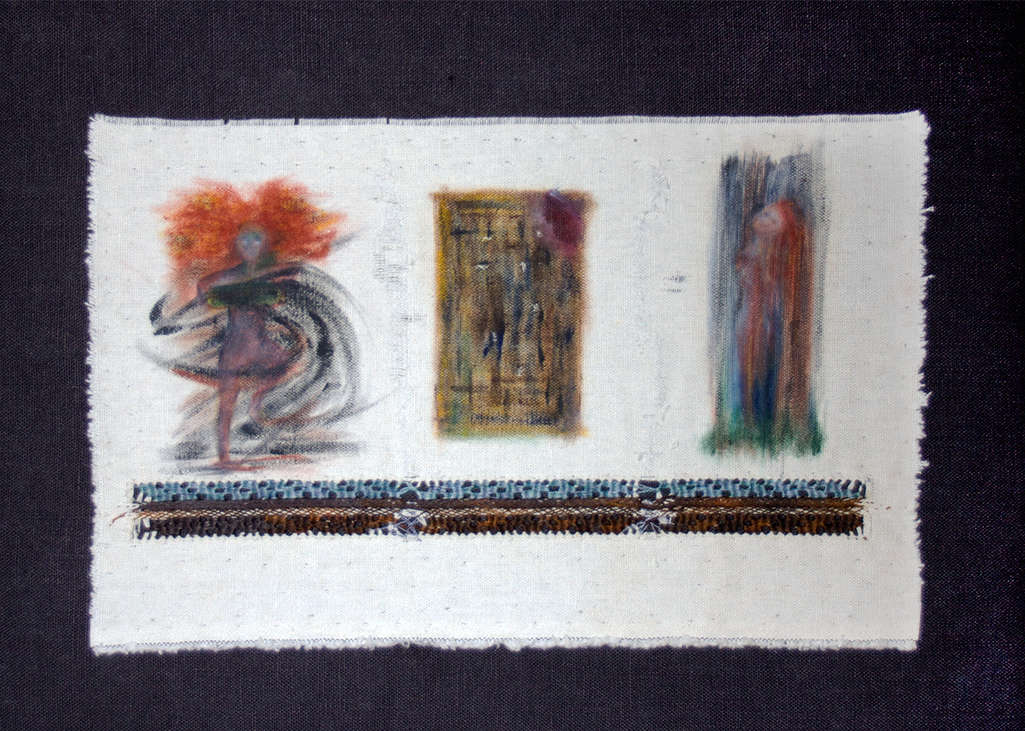
Drawn into Catherine’s Orbit by Laura Wythe
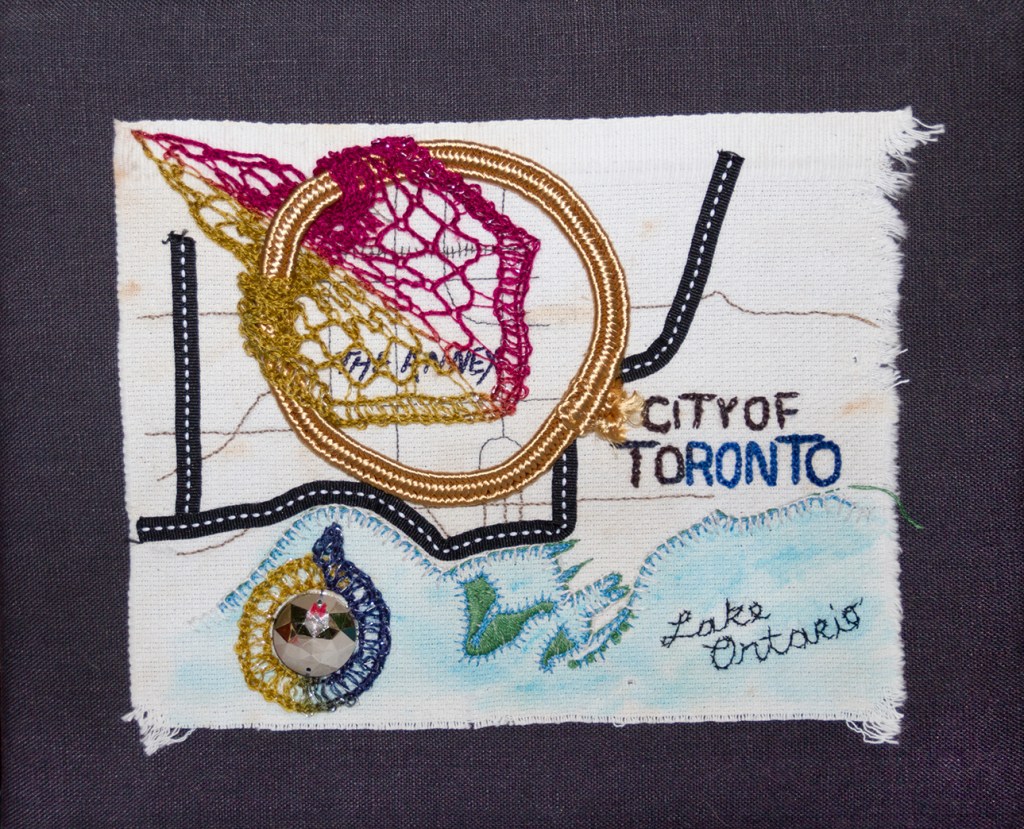
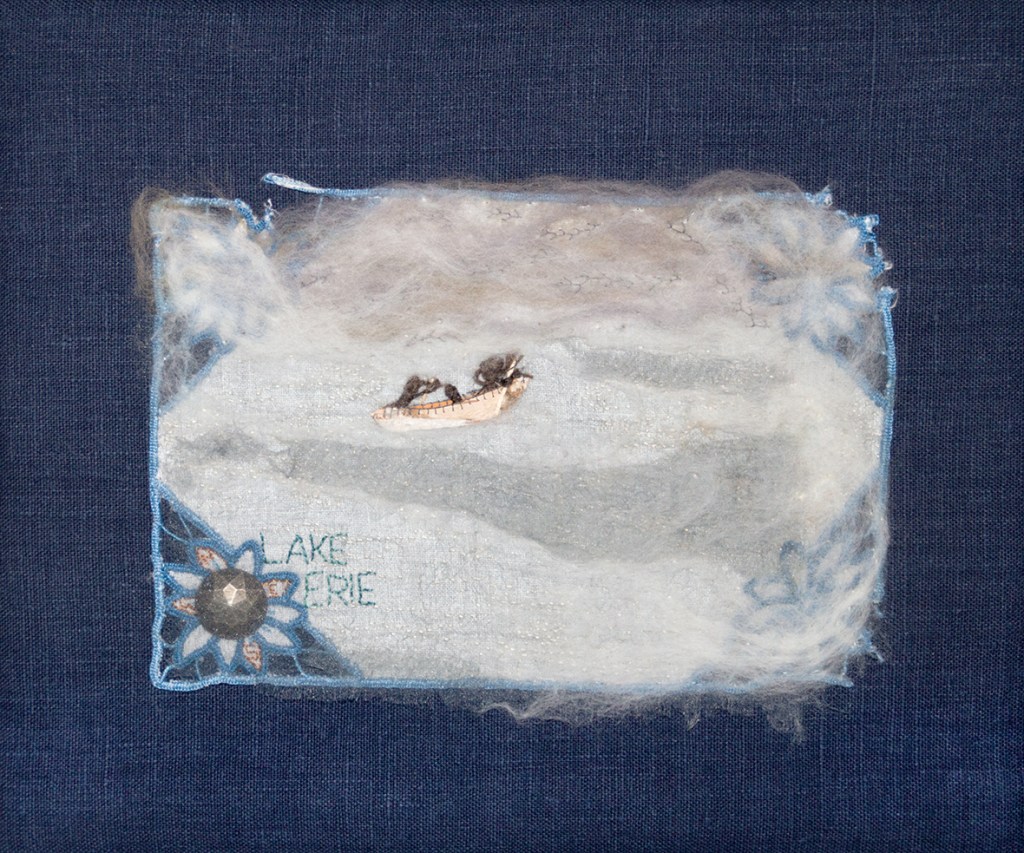
Crossing the Great Lake by Laura Wythe
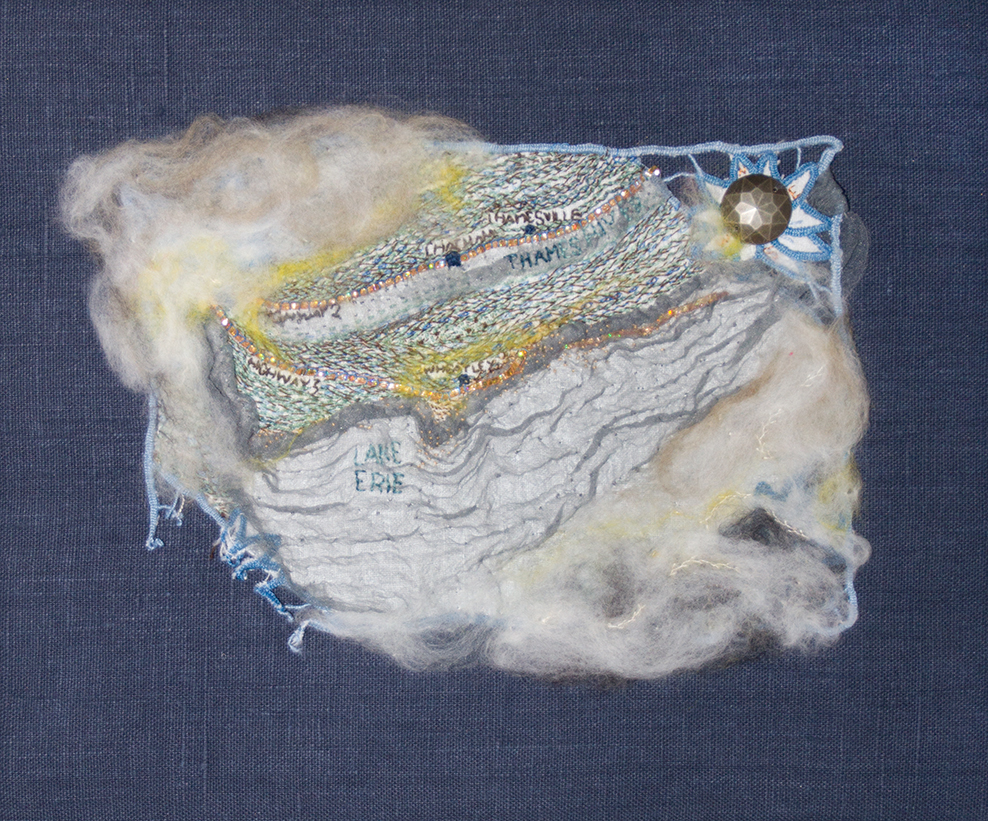
Thomas Waits Where Highway 3 Has Fallen off the Map by Laura Wythe
My friend had a friend lay square bricks in a circle at the far end of her beautiful back garden. It looks like it’s always been there.
There were left-over bricks, and I don’t usually work with bricks, but “borrowed” a few to use as weights for a bookmaking class I’m taking though CEG London. The rough surface needed covered, so I pulled out the thickest felt on hand and made some of those geometry nets like we did in school. I attached the edges by blanket stitching first, then weaving a thick thread though to join the seams and seal the brick up inside. The joining is based on a technique I saw at a Textile Museum of Canada exhibit featuring Central American weaving and clothing.
Brick by brick, I’m approaching the new techniques required for book making, trying to understand. And this finished book cover looks good after a day of rest beneath the felted brick.
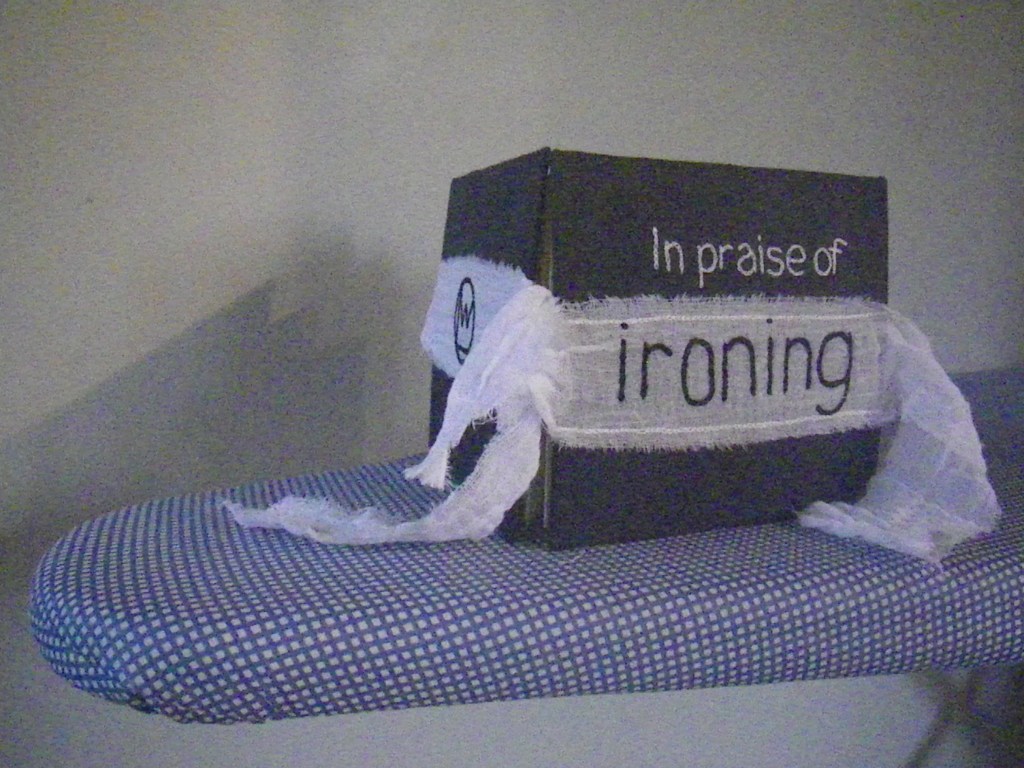
In Praise of Ironing (Pablo Neruda) 2019 Laura Wythe
We whisper a message and it gets passed along. It’s never the same in the end.
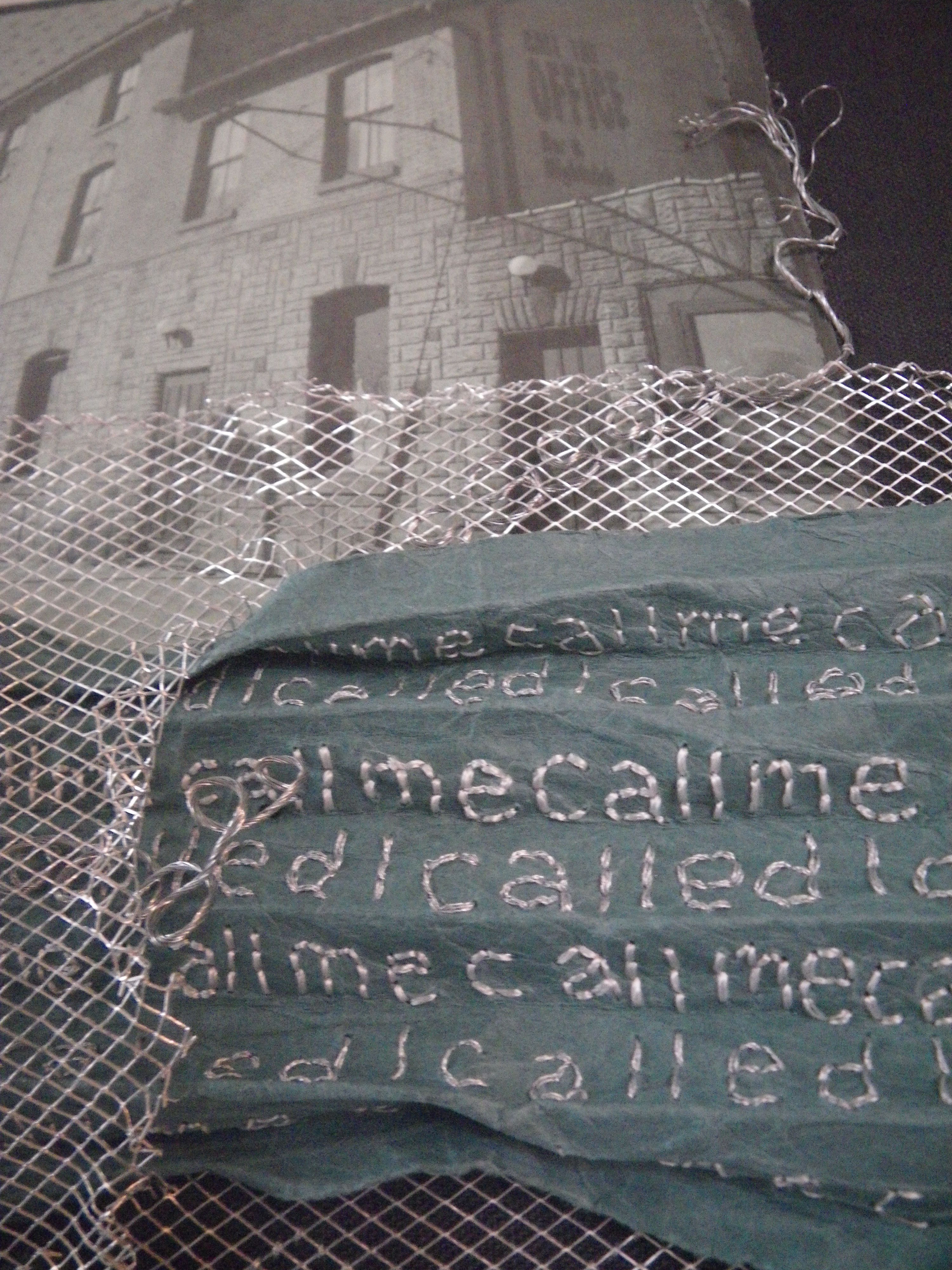
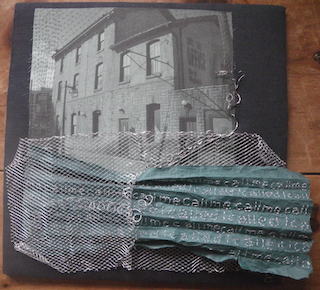
This piece started in a paper stitching class, with picture hanging wire coiled to run through a press to emboss a square of paper. It looks like an old-fashioned telephone cord. Later, I treat green cotton rag paper with konjac paste, and fold and crumple the paper. It is quite sculptural. The feel is of old paper, like matchbooks, kept and folded until they become more than paper. Like memories. once fragile, but oddly more permanent through repeatedly turning them over. I take the coiled wire from the embossing and pierce this paper. A telephone connection is made. I list telephone ideas and choose 2 for a conversation that didn’t quite happen. As I stitch, I ask why not? Why didn’t they connect?
Embroidering on cotton paper treated with konjac Laura Wythe
I remember this colour of green: Call the Office. The paint trim around the tired old windows of this London establishment matches the paper perfectly. Like the paper, it is crumpled but stands up well despite much abuse. It’s where you might meet someone and promise to call.
The fencing is a chance encounter in a craft store, looking for something else. Shiny aluminium mesh to go with the picture wire. Jagged edges.
Missed Call is phone tag, is the whispers game, but on a visual level. Thanks for starting this round of the game — Jan Taylor and Canadian Embroiderers Guild, London
Missed Call by Laura Wythe 12″ x 12″ fabric, wire, aluminium mesh, paper and threads on linen
Dolsen suggested viewing the river from the bridge that remained on Highway 2. They might see a solution by looking downstream. “When we got there,” Thomas told Catherine, “there was already a crowd and they were looking upstream. A mass of crate-like objects was bobbing in the water and coming our way. “‘Munitions on the loose!’ Crudge said. “‘Caskets,’ a bystander whispered. ‘A sign of the Rapture.’” “I warned you that they believed in it,” Catherine said. “They keep calling me for advice.” “Do you believe?” “Only that if they keep pressing their wool suits, the glare from the shine will blind St. Peter. They must remember to use a cloth between the fabric and the iron.” “They really have their best clothes out, ready to go?” “Enough of them.” “If I stay here much longer, I might hope for the same escape.” “As long as you brought your best suit.” “In any case, it was true. The coffins were in amazingly good shape, swollen with the rain, quite buoyant on the river. Frank Dolsen pointed out the masses of drowned earthworms, like small islands, and the air was thick with gulls.”











 laurawythe