I’ve always sewn clothes, made pictures, sculptures–tactile, physical objects that I could share with others pretty easily.
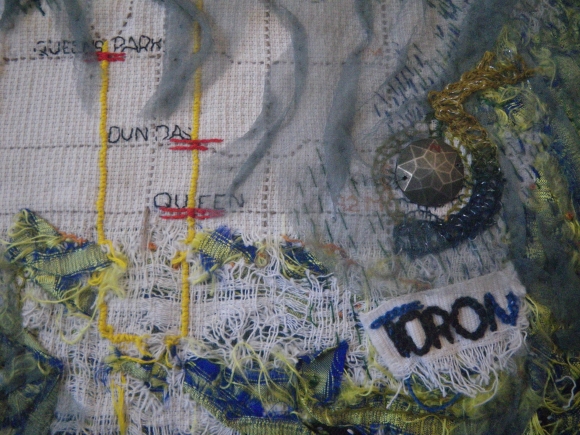
The lakeshore, formerly at 76.5 metres above sea level had risen by 15 metres and was lapping at Queen Street West. From The Bones, Chapter 2, by Laura Wythe
For a number of reasons, writing has become a great creative and personal outlet for me. But how to show and share words? Contests, blogging, writing plays and joining writing groups have worked for short fiction.
Recently I finished a novel, inspired in part by a street in Wortley Village. Tecumseh Avenue is the only native name among so many traditional English names. It took a lot of research to find out the story behind the name, and I used the presence of this First Nation man in The Bones.
The main character is Catherine Blackwood, the textile curator at the Royal Ontario Museum in Toronto. She grew up on a farm next to the battlefield north of Chatham where Tecumseh died in the War of 1812. She heads back to the farm, now in Flood Zone 4, obsessed with making one last search for Tecumseh’s bones. (I’ll blog more about the Tecumseh story.)
I’m used to showing and telling what I’ve been up to. The logical thing — for me — was to make a series of illustrations and launch a book with pictures! Catherine, the textile curator, came to mind as having the perfect point of view for the illustrations.
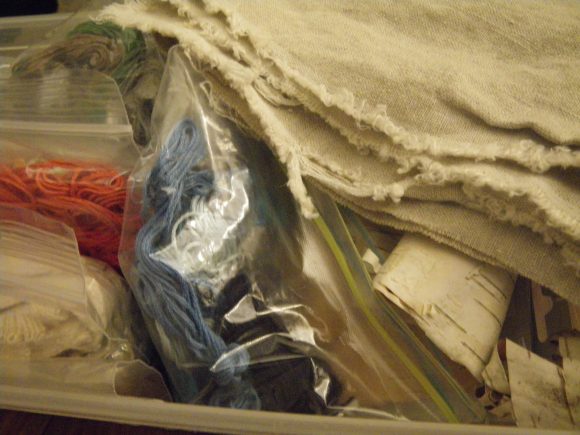
gathering materials for The Bones Laura Wythe
For more than 2 years, I have collected textiles–table linens, threads, and other bits and embellishments. I have pored over maps and charted the travels of the characters through a flood ravaged land. I have joined London branch of the Canadian Embroiderer’s Guild to bone up on my stitching techniques.
I have 4 months left to finish the illustrations, and literally thousands of stitches to go.


 Another title in the Coach House list that caught my eye was And the Birds Rained Down by Jocelyne Saucier and translated from French by Rhonda Mullens. It’s a story about the northern bush north of Timmins, but not in the usual CanLit way. There is suffering, but the woods are the remedy for Saucier’s characters. I don’t know a lot about translations, but I feel like I would enjoy this more in the original French, as the English feels awkward at times. The interspersed history of the Great Fires that raged through the area 100 years ago is pretty interesting.
 laurawythe