Knitting short cut

Easy.

Start with a cast-off, men’s large pure wool sweater from Goodwill’s thrift store, and then go to the best yarn shop in town. Pick up beautiful yarn that costs more than three times the sweater  did.
IMGP1714

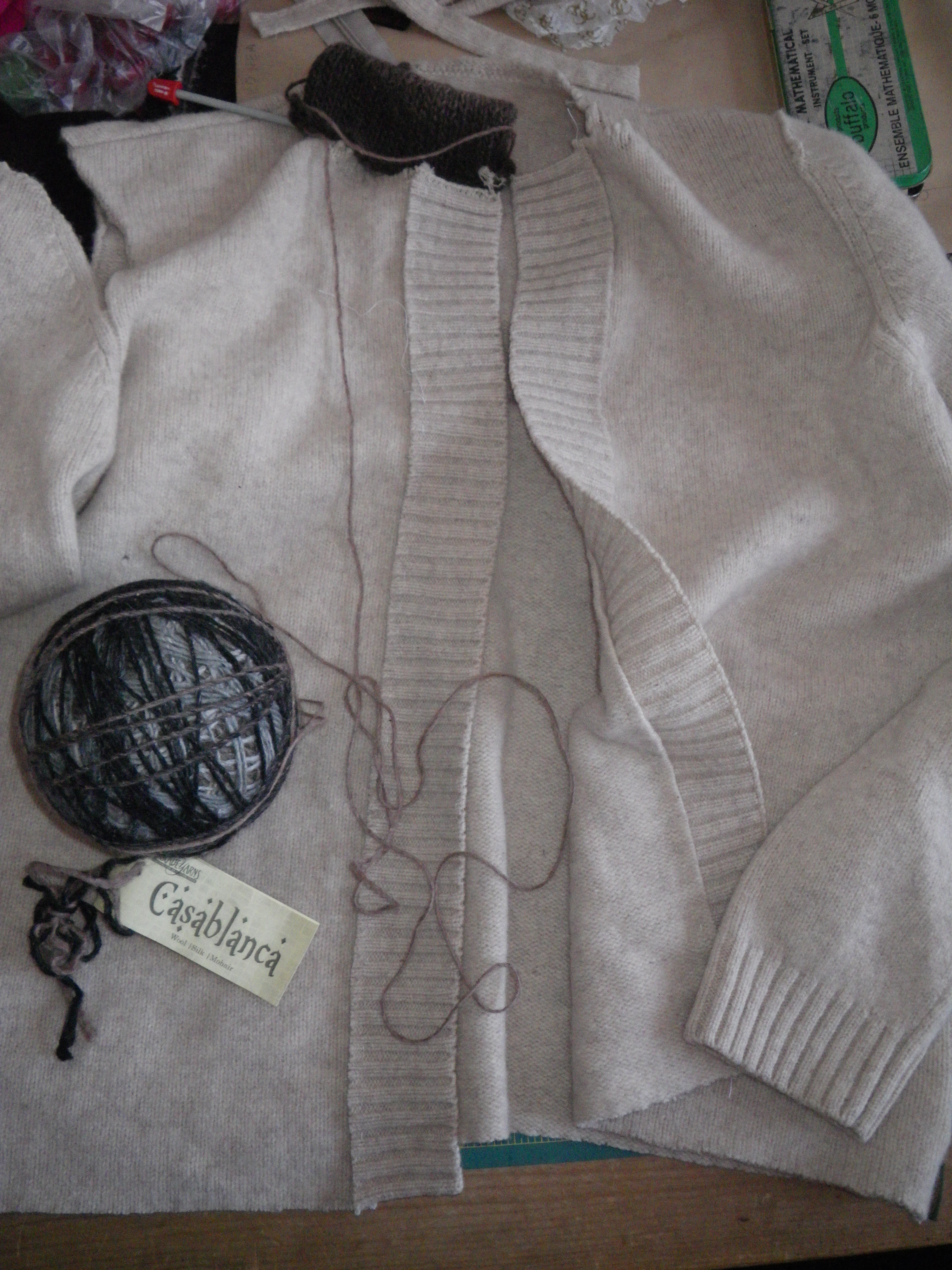
Timberland pullover split for cardigan opening with bottom ribbing cut off and tacked on front openings.

Felt the sweater to within an inch of its life, and try not to poke holes in it as you agitate it in boiling water with a wooden spoon in the kitchen sink. Dry the sweater in the dryer on high heat, a cringe-worthy experience, or most gleeful.

Cut the bottom ribbing off the body of the sweater.  Unpick the short zipper from the placket at the neckline, and the collar too. Be careful to save the yarn from the pickin’s as it matches the sweater perfectly and can be used to sew it up again later. Separate the sleeve caps from the body of the sweater from where they start to curve for the underarm. You don’t have linebacker broad shoulders or want that bunchy look at the bust line.

Casablanca hombre yarn separated into tones.

Casablanca hombre yarn separated into tones.

Get out the beautiful hombre-dyed yarn and unwind it so that each hombre section is wound in in a discrete unit. Turn pale at the thought of cutting up such a lovely skein. Do not cut until you figure out exactly what you’re going to do with it.  A collar, yes. Something at the hem, yes. Some decorative yet sturdy stitch to hold the arms onto the body, yes. But what, exactly?

Fool around with the yarn. Don’t cry when it unravels and comes apart as you cast on. Make tea. Carry on.

Timberland sweater remake details of collar and inset sleeve.

Timberland sweater remake details of collar and inset sleeve.

Decide. Use the leaf motif that you love. It drapes perfectly with this yarn. Calculate for the hem and keep the stitches simple. Knit, knit, knit and it’s done. The tedious body has already been knit on a machine somewhere in the Timberland universe.

Put it together. Use the chain stitch for the major joinings–the front band and arm holes. Remember,  after the yarn breaks about 8″ in,  to twist the yarn tightly at ten minute intervals.  Strong now. When that’s done, use the yarn you unpicked from the sweater to tack the edges down. You don’t want it to look handmade-clumsy!
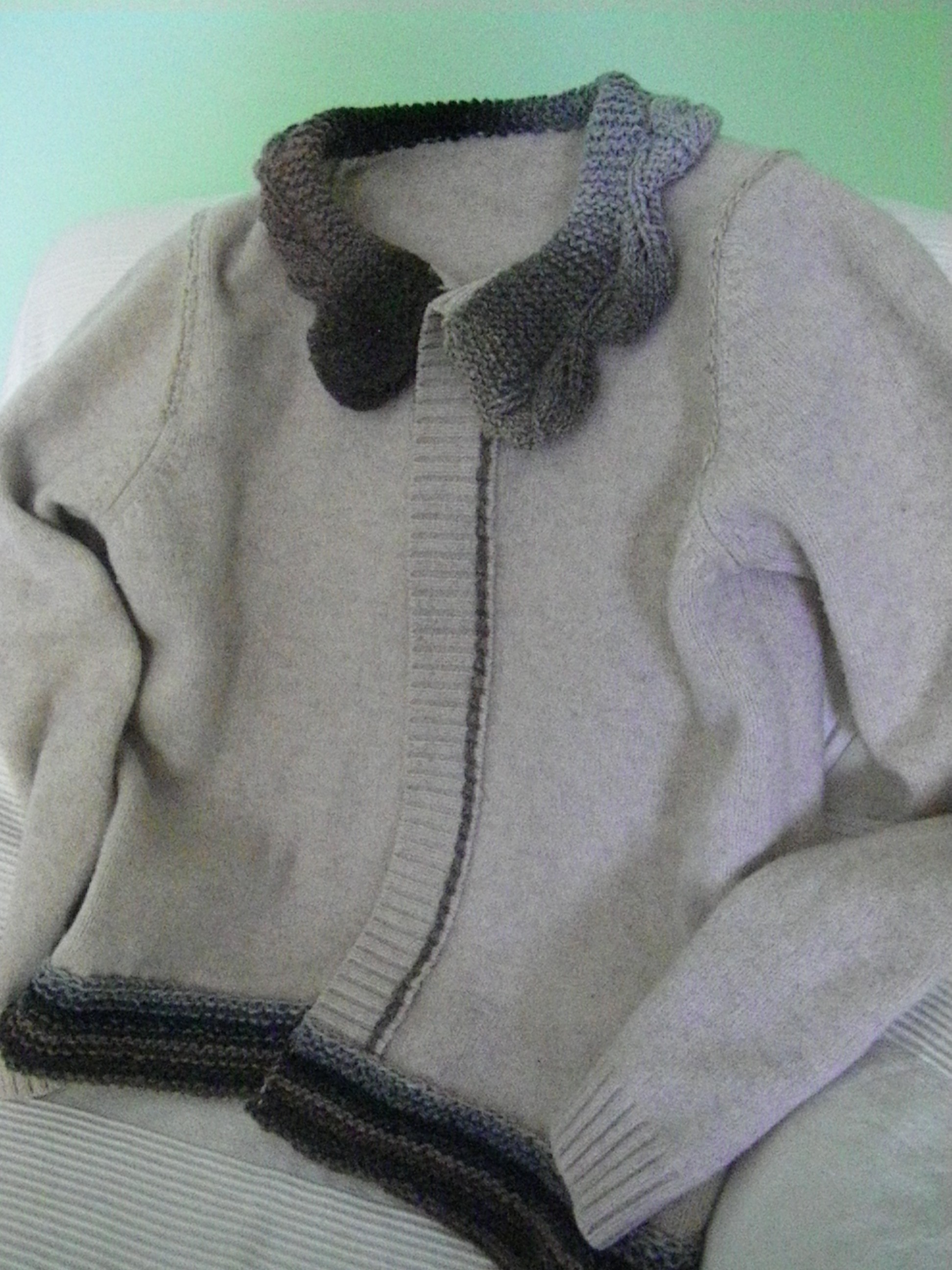
Finished remake of Timberland pullover.

Finished remake of Timberland pullover.

In the end, you will have tried the sweater on one hundred times.  Try it on one last time. Oh, you need some kind of pin or button to close it across the chest?  Return to the wonderful yarn store and pick something up. Take your sweater with you.  The saleswoman who helped you at the beginning of this project will like to see the proof of your creative madness. She didn’t see how it would work.  How could she, when you didn’t either?  You just had the intuition that it would.

Okay, so recycling a sweater seem like it’s as much work as knitting, but it’s different work–combining machine/mass market with hand knitting.  And I kind a like the result.
Tagged , , ,

Out of Africa quilt show

Volunteering for Out of Africa quilt show arranged by the London International Quilt Festival was really cool.  My friend and I spent more time with quilts than we normally would have, and with the other volunteers and the circle of vendors around the room.

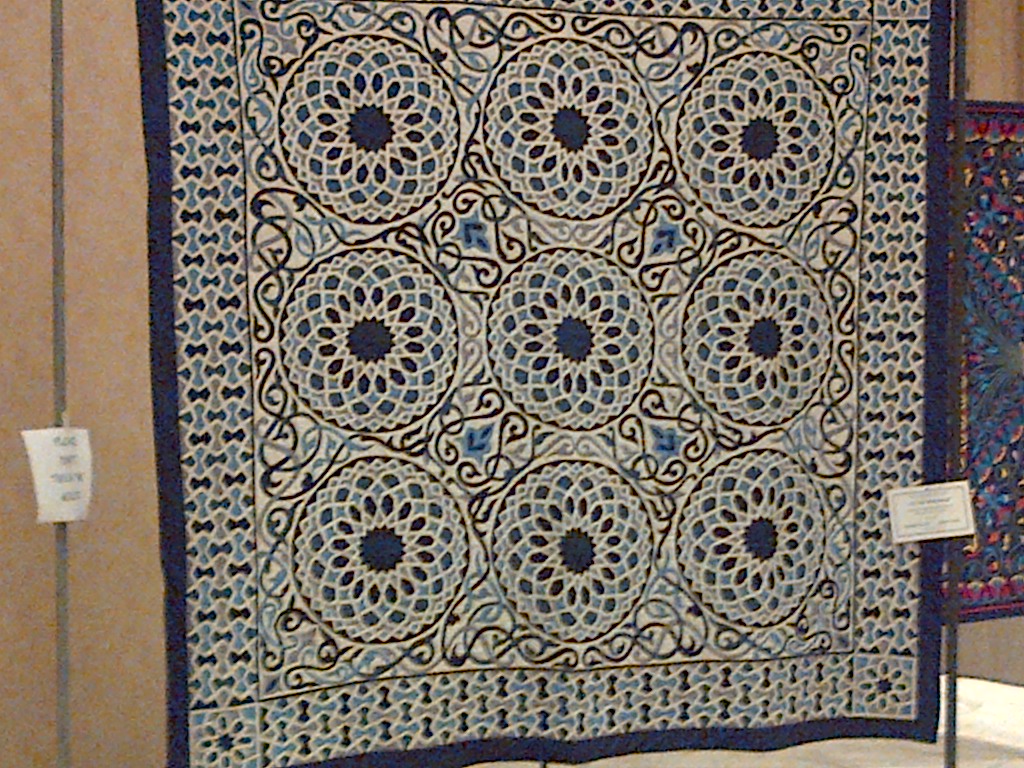
Tent hanging hand sewn by the Men of Cairo, approx 14' x 14'

Tent hanging hand sewn by the Men of Cairo, approx 12′ x 12′

A quilt, apparently, can be broadly defined as a fancy top and a back, with a batting sometimes in the middle.  At this show, there were very few, if any, quilts like the traditional ones my grandmother would make.  Almost all of these quilts from the African continent were meant to hang on the wall.  Stunning “quilts” from the Men of Cairo collective were actually tent walls, and resembled Persian carpets or mosaics. African animals, cultures, traditional and everyday life were celebrated with brilliant colours, sombre desert hues, embroidery and embellishments.

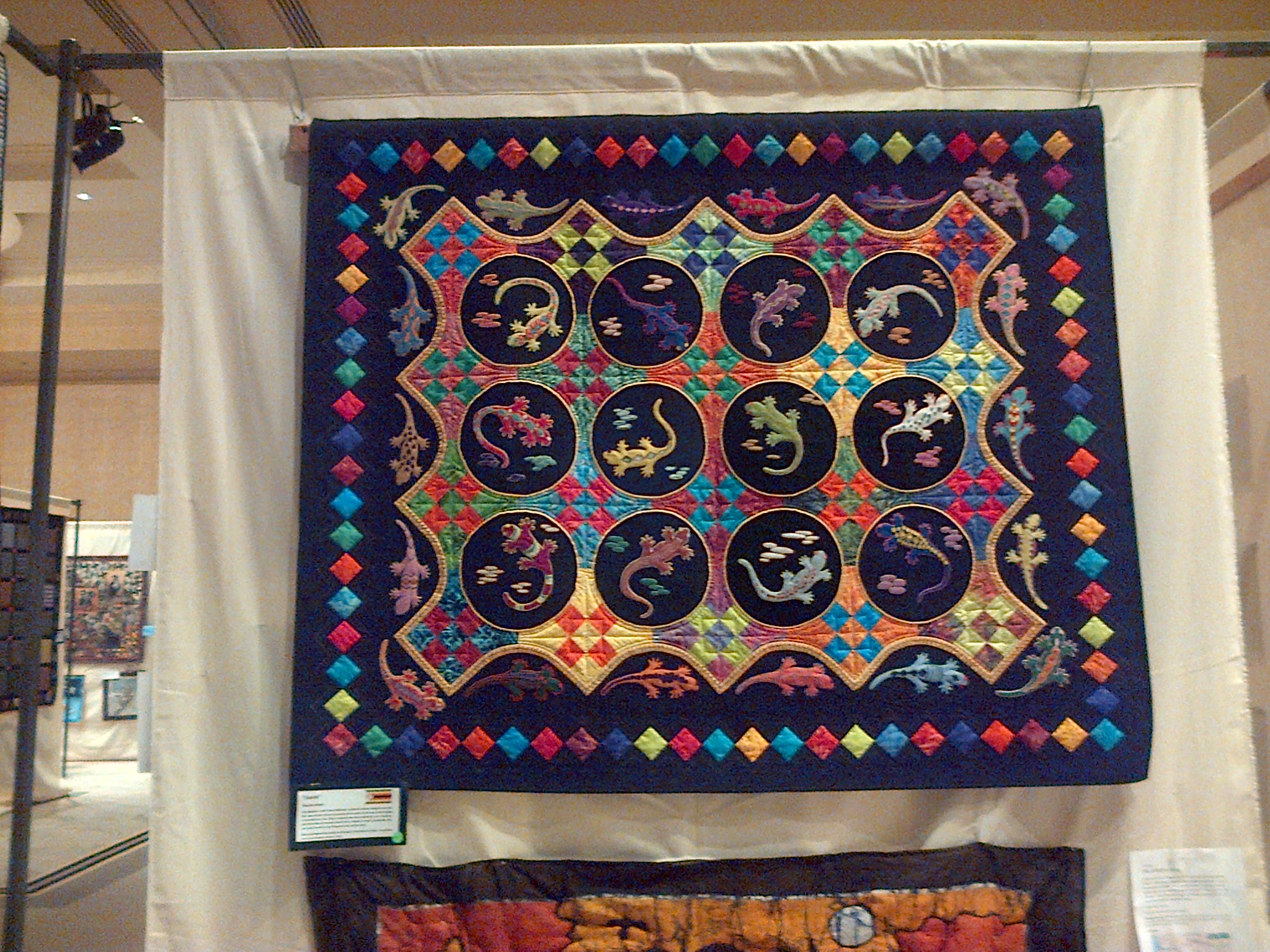
Salamander Quilt, Out of Africa show in London ON, 2013

Salamander Quilt, Out of Africa show in London ON, 2013

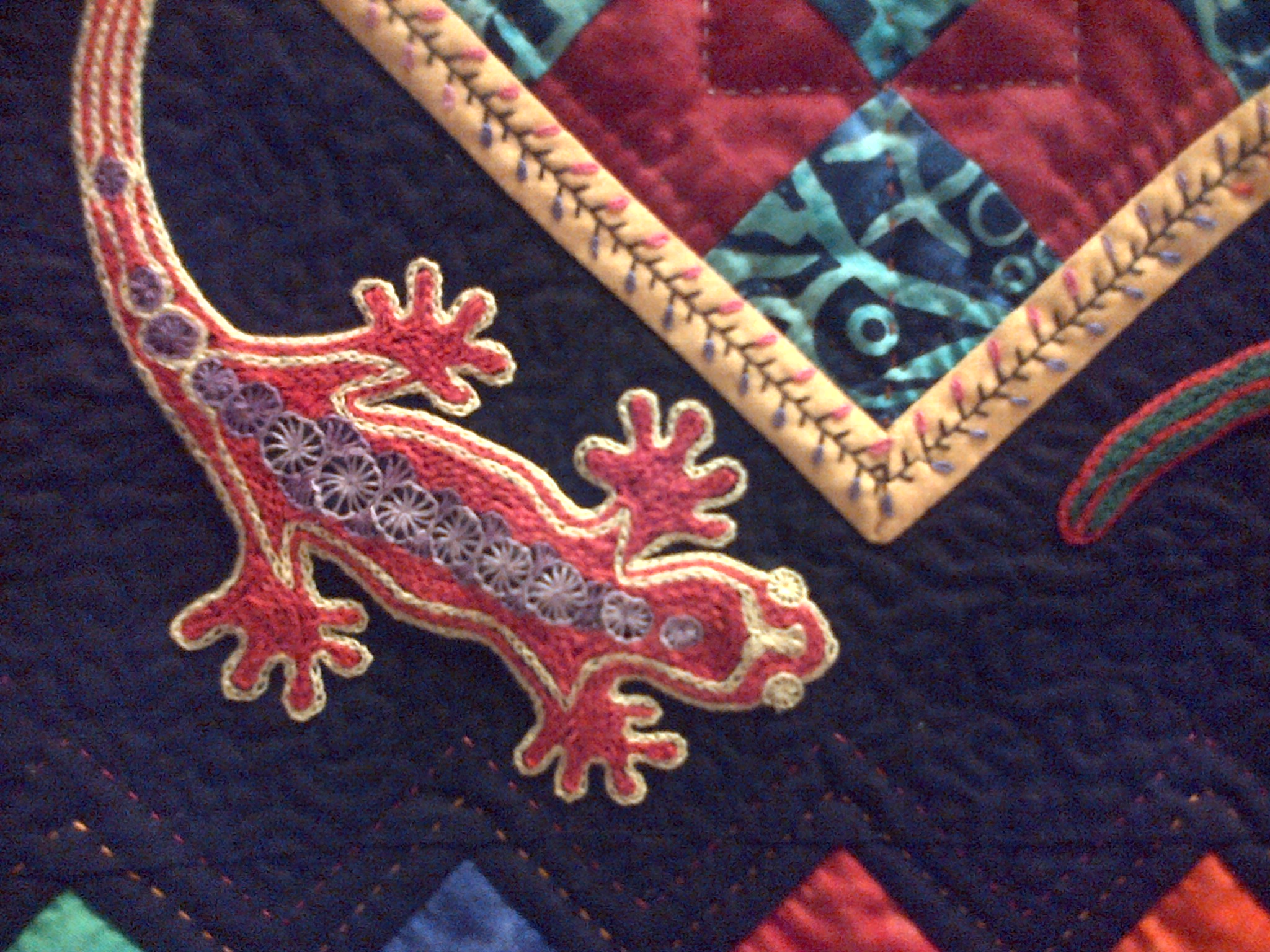
Detail of salamander quilt, Out of Africa, London ON, 2013

Detail of salamander quilt, Out of Africa, London ON, 2013

I didn’t get to the lecture on the African quilts, but I did meet a volunteer, Hasebenebi Kaffel who knew the subject in broader terms.  I mistook him for a member of the Men of Cairo collective.  He really works for the UK-based ACORD and has been to Cairo many times, he said.  Also a member of ACFOLA, he was at the show to volunteer his knowledge of Africa.   He told me how long ago he fled his home in Eritrea with nothing, and then ended up in front of the World Bank to deliver a paper on the importance of gender in the economics of developing countries.  Very interesting!

Alas, I did not make any purchases.  There were vendors from all over the world, but instead of getting into something new, I vowed to finish the quilt that I started 30 years ago.  I know, I’m amazed at how quickly time has passed. “The Wedding Plate” is pieced bits of fabric from projects that my sisters and I made in our teens–dresses, PJs, blouses, pot holders, whatever–and I need to finish the quilting and bind it.

It’s good that Africa came to London, for the education, inspiration, and the joy!!

Tagged , , , ,

Yarn “bombing” in the Capital

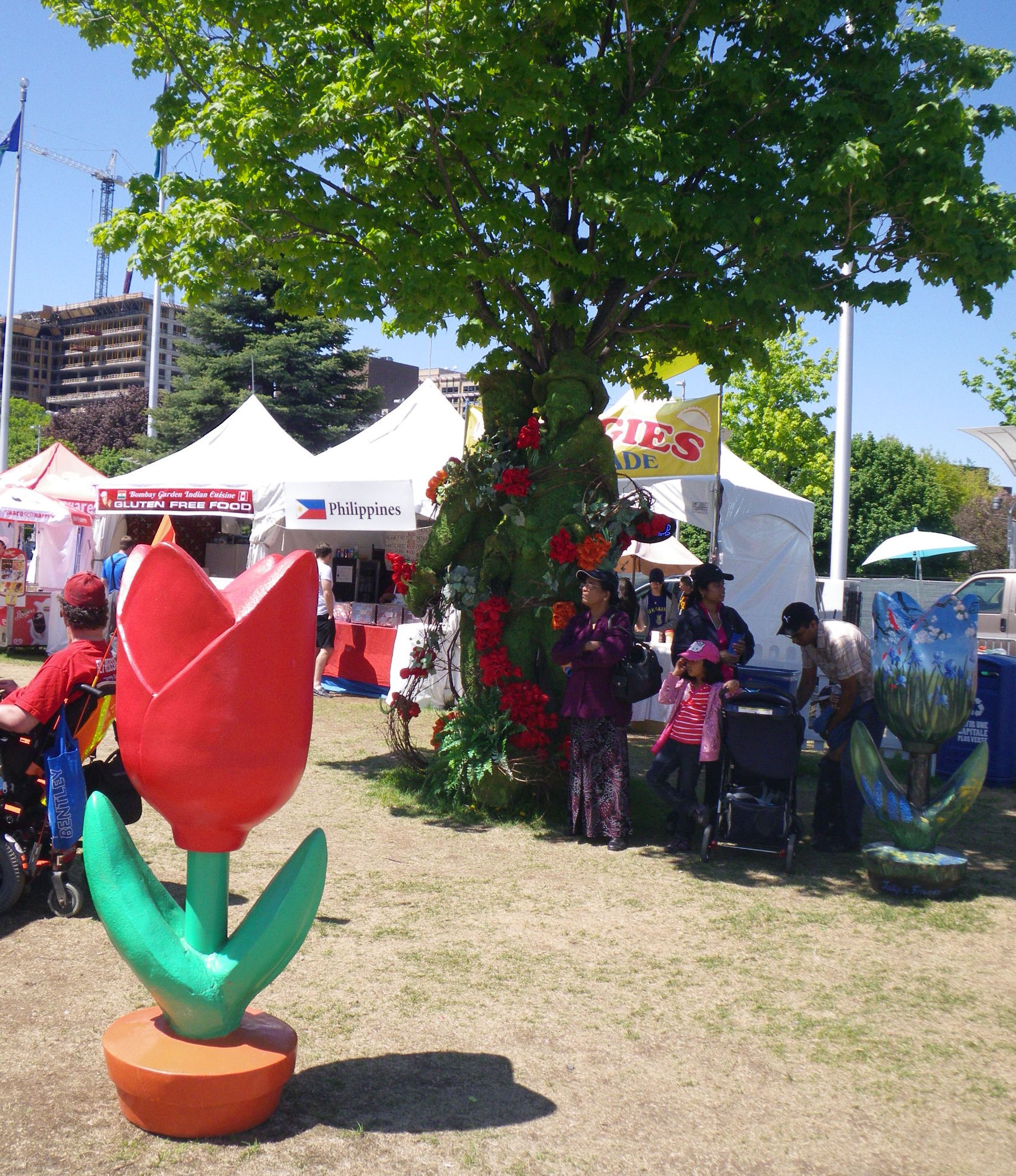
Tulip Festival, city Hall, Ottawa, Canada

Tulip Festival, city Hall, Ottawa, Canada

The Tulip festival was in full bloom when I visited Ottawa.  Ties between Canada and Holland, made during World War II, continue and I love that it’s through planting flowers and not through war memorials.  The activity of planting bulbs each fall and waiting for the winter snow to melt, for the tulip bulbs to burst into our Canadian spring, however short it may be, is full of hope.

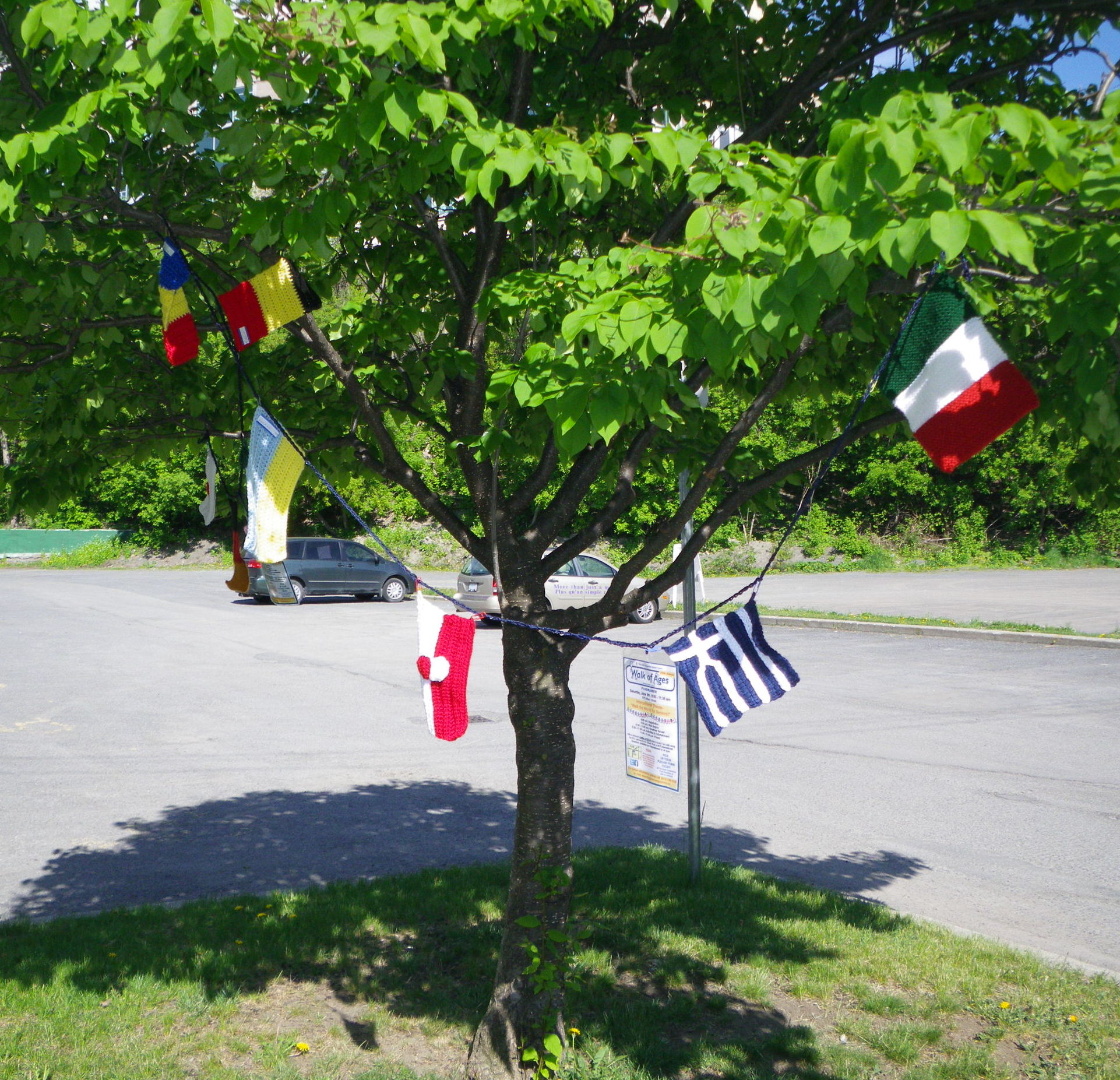
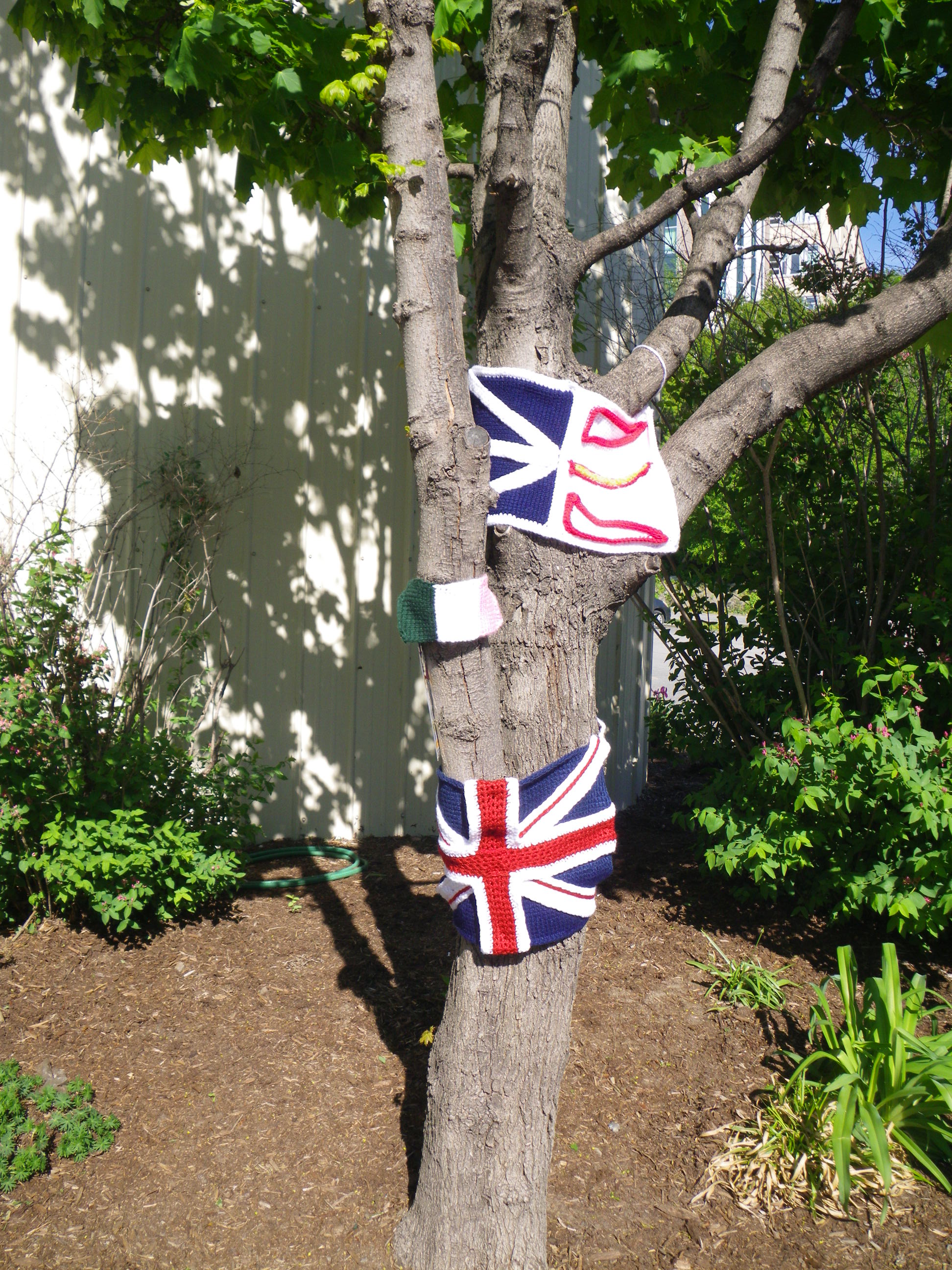
I walked back to my daughter’s house after checking out the Tulip Festival activities at City Hall, past the Nanny Goat Hill Community Garden, and then I came across a yarn bombing by seniors in the trees in front of The Good Companions Seniors’ Centre.  They are getting ready for their annual Walk of Ages fundraiser.  All the flags attached to the trees were knit or crocheted.

Yarn bombing in front of The Good Companions Seniors' Centre, Ottawa Canada

Yarn bombing in front of The Good Companions Seniors’ Centre, Ottawa Canada

Yarn bombing at The Good Companions Seniors' Centre, Ottawa

Yarn bombing at The Good Companions Seniors’ Centre, Ottawa

Yarn bombing at The Good Companions Seniors' Centre, Ottawa

Yarn bombing at The Good Companions Seniors’ Centre, Ottawa

Imagine the history of the last century if this tactic had been used.  If Dickens had written not of Mme Lafarge merely watching the beheadings and knitting the names into the fabric, but of her knitting covers for the guillotines, crocheting a woman’s discontent and fixing it to icons of her displeasure.

Perhaps more lives can be saved as cunning fingers wrap yarn around people and place.

The Good Companions Seniors' Centre, Ottawa

The Good Companions Seniors’ Centre, Ottawa

Tagged , , , ,

Mother’s Day memory

My mother and her sister were named after the months they were born in:  May and June.  Both have Alzheimer’s.  Patricia May has passed away and but my mother ticks on.  Here’s a section of a short story(fiction) that I’m working on about ‘June’ remembering Mother’s Day and then Father’s Day as she tries to take in the news that ‘May’ has died.  

They say no. She is not yet beside Mother and Father. Good. Tell them that on Mothers’ Day we pin a white carnation from the vase in the church narthex onto our cardigans and then we sit in the family pew waiting for the service. The pastor will deliver homilies of two kinds. May and I discuss how we would rather wear pink or orange carnations, and so we return the white ones to the vases in the narthex and pin the coloured ones on with long hat pins. The deacon notices and kindly says that there aren’t enough coloured flowers. Would we mind trading ours for the white again? We are mortified. Mother only pins coloured carnations onto our cardigans.

Father’s Day is less complicated. We take fish and chips to the pond and share a great bottle of dark ale, wiping our greasy hands on the grassy bank, putting off our shoes and socks afterwards to dangle our legs over the edge, fishing bits of coleslaw from the Styrofoam container and tossing the limp strands onto the water, calling up the fish as though they are our friends, kicking our feet hard in tandem so that whenever the minnows do surface, we have created tidal waves for the poor things. Father would like to choke us girls for scaring the fish away, for disturbing them, yet he has no qualms about tricking the fish with worms and impaling them with hooks in the first place.

For more reading about mothers with Alzheimer’s, try this graphic novel: Tangles: a story about Alzheimer’s, my mother and me by Sarah Leavitt.

Tagged , ,

C publishers: ChiZine and Coach House Books

So, I’ve finished writing a novel, The Bones, and of course I want to put it out there.  But the business of writing differs hugely from the craft, so it’s time to to do some research. The overall goal is to find a kindred spirit who will love to get my  book out there.

At this time, I’m going through the directory of Canadian Publishers. B was interesting, with one nibble.  Then it was time for the Cs. I almost went down to Sarnia’s GenreCon in April to pitch my novel to ChiZine, publisher of DARK works. The World More Full of Weeping by Robert Wiersemaon was on their list, but the book wasn’t in the LPLibrary, so I got out Before I Wake by the same author. Really cool story, which I found not so DARK but rather hopeful.

After ChiZine, comes Coach House. They unabashedly like Toronto and all things related in their non-fiction. I do situate the beginning of my novel in Toronto, so that’s good. For research, I started with Andrew Kaufman’s All My Friends are Superheroes. From the title and book cover, you may guess this novel is a weighty tome about the existential angst of Canadian identity involving world events in the Middle East–or perhaps Brighton. You would guess wrong! It’s a perfect darlin’ of a love story.

Another title in the Coach House list that caught my eye was And the Birds Rained Down by Jocelyne Saucier and translated from French by Rhonda Mullens. It’s a story about the northern bush north of Timmins, but not in the usual CanLit way. There is suffering, but the woods are the remedy for Saucier’s characters. I don’t know a lot about translations, but I feel like I would enjoy this more in the original French, as the English feels awkward at times. The interspersed history of the Great Fires that raged through the area 100 years ago is pretty interesting.
Tagged , , , , , , ,

Setting the table

Linen napkins cut from a vintage tablecloth.

Linen napkins cut from a vintage tablecloth.

Maybe this is a generational thing, maybe it still happens, but family dinners on Sundays and holidays used be quite formal.

At the centre of it all was the large dining room table.  During the week, it might the place for doing homework, for cutting out sewing patterns, or once at our house, for a quilting bee.  On holidays, the table was extended to fit 12 or 14 people.  The boards that extend the length are called leaves, as though we were adding to a tree.  The final act of transformation came when the white linen cloth was placed on top.  Pure, fresh.  A sacred space created.

In the afternoon before the dinner, real silverware, bone china dishes, wine glasses, a centrepiece,  napkins, serving dishes, butter dishes, crystal stemmed salt and pepper shakers, and gravy boats were set out on the white sea.  The table was set.

Recently, I met Marilyn, who told me she is in her eighties and  how she found some table cloths that she had no use for, but there were memories attached.  She asked me over for coffee, then spread out her mother’s and grandmother’s linen table cloths on her dining room table.  They’d been well-used.  Here’s where the gravy spilled, still a large yellow stain.  And there were holes, small ones from the wear of weekly washings, and a large plate-sized one.  Perhaps a hot pan had burned through.  Marilyn asked if there was enough “good” fabric to make a set of large table napkins, as a keepsake for her niece.  To throw the linen out seemed wrong.

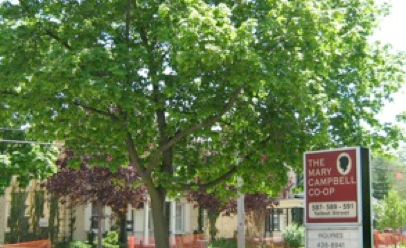
The Mary Campbell Cooperative on Talbot Street, London ON

The housing cooperative on Talbot Street, London ON named after Mary Campbell.

When I delivered the set of eight large linen napkins, Marilyn didn’t look at them right away.  Instead, she talked about another kind of table she’d sat around.  When she’d first come to London, she  became friends with Mary Campbell, also from the west, but an activist who would start a co-op movement in this rather white-collar city.

Marilyn remembers the Campbells’ table, how she read there, reading things she didn’t always understand: Communist treatises, trade union booklets, socialist literature.  She remembers falling in with a movement where working as equals was preferred, and then having the courage to leave a bad marriage and go to college to become a social worker.

Now it’s a choice for a woman to stay in a marriage, but 40 or 50 years ago, to leave brought on a lot of judgement and shame, like spilling gravy or red wine on the white table cloth.  I thanked Marilyn for her courage, for making it easier for the women of my generation.  It’s not that we don’t love the traditions, the white linen and beautiful place settings, but we know there are other tables, tables set with a different cloth.

Tagged , , , ,

Never Cry Wolf, another model, a lot more love

The reference to Farley Mowat was right, and I must have liked the workings of Mowat’s anti-bureaucratic mind enough that his philosophy and a bit of his wisdom has stuck.    Never Cry Wolf is about a young, naive, biologist flying into the north tundra, and his literal face-to-face meetings with the wolves.  His openness to what he really saw, a de-bunking of the myth of the wild, and of wolves beyond self-serving human narratives like Jack London’s, has become a model for wildlife management.

The best descriptor of the Never Cry Wolf relationships can be found in the Duluth Model of Equality, the changes needed to encourage a shift to non-violence in an abusive relationship.  Mowat would encourage us to give up our violence and learn a more peaceful way from the wolves.  I learned about the Duluth Power and Control Wheel through volunteer training with the London Abused Women’s Centre.  It describes the use of violence to exercise control, and I have posted them below, with love.

A great guide for any relationship.  Wish business/government culture would adopt it universally.

A great guide for any relationship. Wish business/government culture would adopt it universally.

Call of the Wild approach, so old-school.

Call of the Wild approach, so old-school.  No need for aggression.

And so Mowat does pee out a boundary and you’ll have to read the book to see if it really does work.  And so my short story was built on the wisdom of an elder, who offered a great alternative to the violence of conquering.

Tagged , , , ,

198 Church Street, common ground

I didn’t know what I was getting into when I emailed a woman about her advertisement for free copy editing in the London Writers’ Society newsletter.  She turned out to have a good eye for missed words, inaccurate spelling, and phrasing that could be better.  Sue had a background in speech pathology, she told me over our first cup of tea.  She was from Stratford, at least that’s where her parents had lived the longest, where she graduated from high school.  I was from Stratford too, I told her, but we were a number of years apart in age, and didn’t have any real connection that way.

186 Church Street, Stratford, Ontario

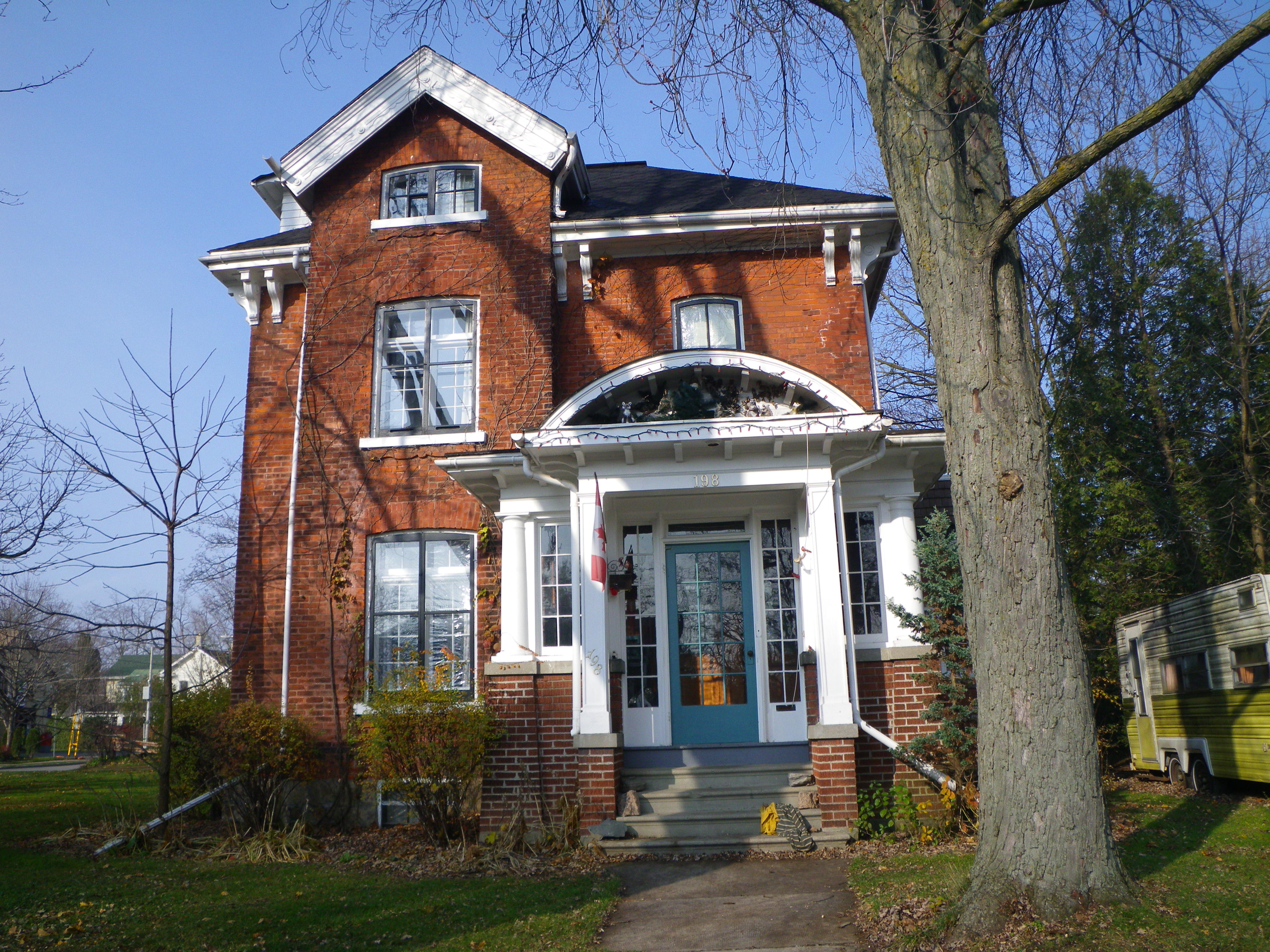
198 Church Street, Stratford, Ontario

Then we discovered we had lived in the same house.  Her family had come from a small town and her father was to become a high school principal.  My family came from Toronto and my father would become the VP Finance for a furniture manufacturer.   Our families’ first homes in Stratford were the same place, on the second floor at 198 Church Street.

Sue remembers her mom getting groceries delivered from the corner store and her grandfather having a room in the attic.  I was only four, but I remember the bats descending from the attic into the living room, and the sturdy crab apple tree where my brother got caught in the branches with his winter coat and swung from it, as though he was in a cartoon.

Neither family stayed long.  We moved kitty-corner through the block to rent a whole house on the corner of Birmingham and St. David streets until our new house in the suburbs was built.  Sue’s family moved to Mornington Avenue across the street from St. James Church.

Apparently there was a pattern for professionals with families immigrating to Stratford.  Perhaps first, they had to pass through 198 Church, second floor.

Call of the Wild, really?

It’s funny what sticks in one’s mind.  There’s so much information around us that I find some of it isn’t quite what one thought after it’s been fact-checked.  Memory glitches, brain farts, stupidity, or perhaps, serendipity.

Recently I workshopped a short story about a farmer who was peeing to mark his territory against coyotes, and someone in the critique group mentioned Farley Mowat had done that, hadn’t he?  The bit of information seemed familiar, a sticky bit, and I wondered if I was referencing Mowat in the story.  I searched the library and came away with a totally different book, Call of the Wild by Jack London.  

Not the right book, not all.  Major brain fart.  But what harm could come from reading a children’s classic?  Through Buck, the dog, London develops a thesis of power and leadership that is cunning and Machiavellian, claiming it is “natural.”    What had inspired my story was a totally different way of being in the wild.   I made notes, mentally, about the way Buck went after power among his fellow dogs, how he became a leader.  I think I’ve used, and been on the receiving end, of some of the techniques.

Call of the Wild was not the book I wanted to read.  It’s a violent, Lord of the Flies classic where the wild is savage.  Yet it reminds me that there are narratives all around us about using violence to cripple others, to seize power.   In some areas of the world, the violence is physical.  Closer to home, the violence is more through withholding resources and information, character assassination, isolation.

This makes politics difficult, when it’s about power rather issues.  I can’t remember where I read this, but someone said that a campaign for justice is on the right track when the attacks become personal, when the isolating begins.  That it’s part of the cycle of change and it’s bloody.  But it’s a mark of being on the right path.  I think of Maude Barlow as being an example of this.

Another version of the wild is still stuck in my head.  It’ll be interesting to see if Never Cry Wolf is the story where the man marks his territory in the wild with his pee, and not with firearms.  I’ll be tracking the book down, circling the text, isolating the words when I find them–not to savage anything but to understand.

Parts of Canada we seldom see

My friend Charlotte and I went to the opening of the medium gallery (yes, it’s all lower case) in the Old East business district on Saturday night.  In 2011 a photographer, Johan Hallberg-Campbell, had flown into the bush of northern Ontario with the Canadian Red Cross to photograph their efforts to supply Attawapiskat with sleeping bags, heaters and winter clothing.

Attawapiskat

This poster photo is the least representative of the exhibit, a romantic, christianized image, and it was placed next to a photo of a beautiful but very sad young woman living in the crawl space beneath the floor of a house, her arms marked by cutting.

Hallberg-Cambell said, to paraphrase, that while he was in Attawapiskat, he didn’t want to traumatize the citizens there.  He found them to be gentle and kind people, and he knew the general media was using images for articles that would result in misunderstandings, or misrepresentations, that would further politicize the situation.  The images he chose for the exhibit were personal and sincere. It was well worth the visit.

Years ago I lived on another northern Cree reserve in housing that was trucked in, just as the housing is being trucked into Attawapiskat.  The 3 months I spent at the Red Earth IR have had a huge impact on me.

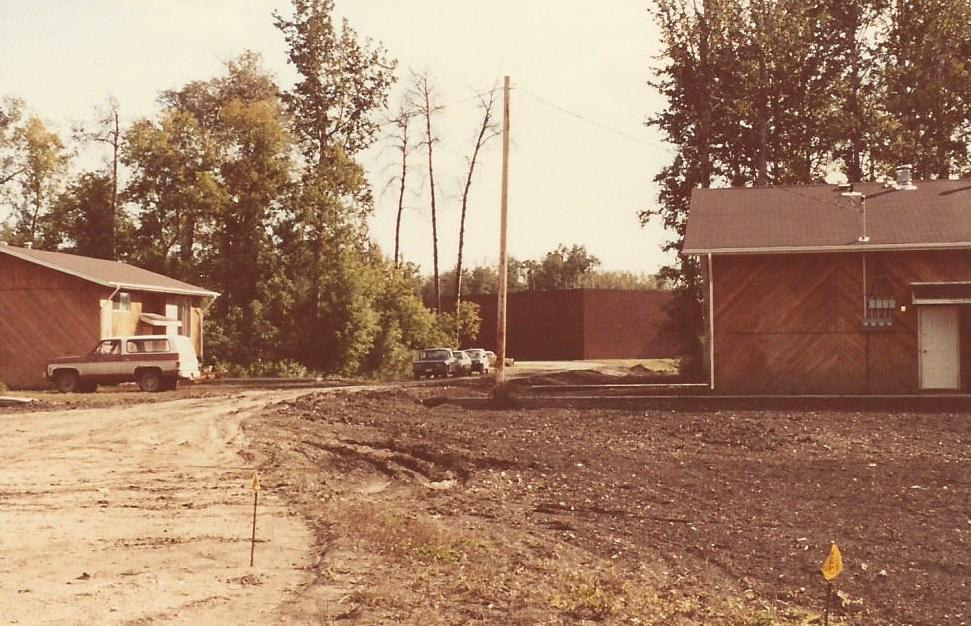
The newly built high school and two 4-plexes for used offices and teacher housing on the Red Earth IR, Saskatchewan.

The newly built high school and two 4-plexes for used offices and teacher housing on the Red Earth IR, Saskatchewan.  The only new buildings I saw on the reserve.

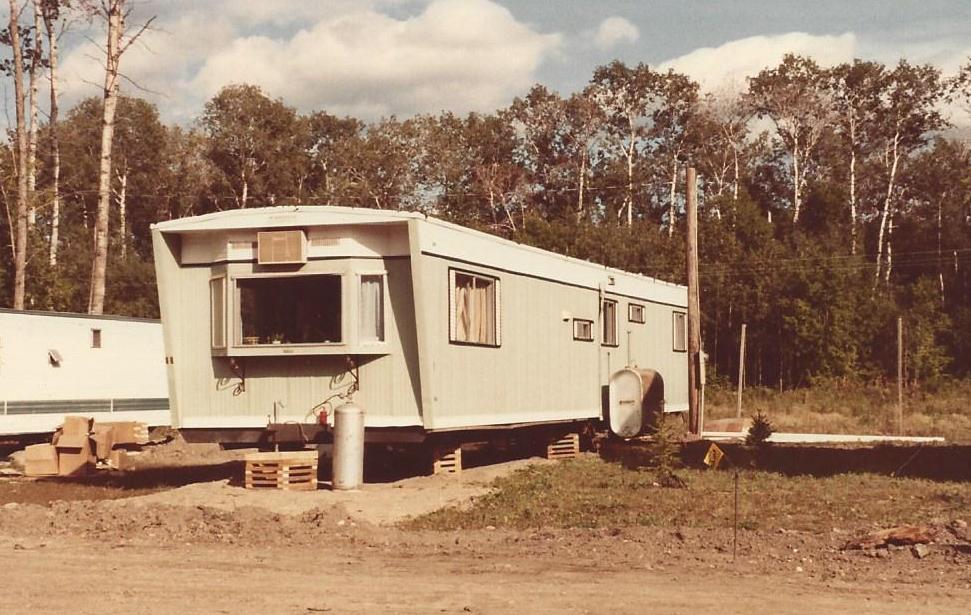
The trailer i lived in, newly trucked in and waiting for insulation and skirting.

The trailer I lived in while teaching in Red Earth, Saskatchewan, newly trucked in and waiting for insulation and skirting.

The housing I lived in was considered “new” housing on the reserve, a used trailer with frustration already punched into the walls. The gas for the stove came from a big propane tank that looked like a bomb at the edge of the clearing, beside the tree that the bear liked to maul. Our neighbour in the next trailer had a small gas explosion after he came home and lit the pilot light.  The hospital was over 80 km away, but luckily his burns weren’t severe.  And we were teachers, told that our housing was “nicer” than most of the residents.

As the seasons turned from Saskatchewan prairie summer to fall and then winter, I came to know more about the resiliency of the people who held on despite the incredible patronizing system that kept the once vibrant community dysfunctional for decades. I can relate to how Halleberg-Campbell photographed both the life-threatening poverty, the trauma and the beauty of the gentle souls in Attawapiskat.

Horses were still part of the treaty agreement, and they mostly ran in a herd fending for themselves against wolves and bears.  The Cree at Red Earth still rode them, just had to round them up first.

Horses were still part of the treaty agreement on Red Earth 29, and they mostly ran in a herd fending for themselves against wolves and bears. The Cree still rode them, just had to round them up first.

All those years ago I was shocked at discovering the biggest “secret” in the Canadian family closet.  The missionaries of my childhood church had us folding bandages and diapers, collecting school supplies and donations for Africa.  Our grannies should have have been knitting and praying for those on the reserve I worked at. I didn’t know third world conditions existed in Canada.  Our schools should have told us about contemporary “Indians.”  Our treatment of them remains appallingly political and needless to say, less than christian.  As a direct result, I became a feminist, an atheist, an activist.

The medium gallery is part of a community economic development project in the Old East area of London, Ontario, where a large percentage of the residents are also struggling with neglect, poverty, mental health, drugs and prostitution.  The anti-poverty advocacy group, Life*Spin has spear-headed this new development.  Their neighbour, Artisan Bakery, also opened on the same night.

Tagged , , ,